Search Results are Changing, but Websites Still Matter
Google’s search results used to follow a predictable pattern: type a query, scroll through ten links, choose one. That pattern is starting to disappear. Google’s AI Overviews now appear at the top of many search results, summarizing information directly inside the results page. Instead of sending users to several websites, Google’s AI composes a single response built from multiple sources. At first glance, it feels like websites are being pushed aside. The good news? They aren’t.
AI Overviews still rely heavily on content from real websites. Every summary is built from information Google considers trustworthy enough to cite. If your content is clear, authoritative, and structured well, it can become one of those sources. That’s the new opportunity in search: not just ranking, but being referenced.
What AI Overviews Actually Are
AI Overviews are generated summaries produced by Google’s large language models (LLMs).
AI Overviews are generated summaries produced by Google’s large language models (LLMs). When a search query suggests the user wants a quick explanation – how something works, what something means, how to solve a problem… or find recipes for the best tater tot hotdish – Google may generate an AI response instead of only listing traditional search results.

Those responses combine information pulled from multiple web pages. Google then displays links to the pages it relied on. In other words, the AI answer is not replacing websites. It’s curating them. This distinction matters. The businesses that structure their content well become the sources AI systems rely on. The ones that publish vague, generic material rarely appear.
But wait, there’s more good news. There are opportunities to be cited in Google’s AI overviews, but there are also opportunities to be cited in other prominent LLMs like ChatGPT, Claude, Perplexity, and Gemini – we’ll bring you more information on this later.
What Google’s AI Systems Look For
AI Overviews tend to reference pages that make information easy to extract. The algorithm is not looking for the most clever writing or the flashiest design. It is looking for clarity.
Pages that perform well often share the following key traits:
None of these signals are new. They’re simply more important now.
Structuring Content for AI Visibility
Most websites lose visibility in AI results for a simple reason: their content is difficult to interpret. Pages written primarily for marketing often contain vague language, long introductions, and scattered ideas. AI systems struggle to extract useful information from that type of content. A stronger approach is to organize information in a way that mirrors how people actually learn.
Begin by addressing the core question directly. Once the answer is clear, expand on it with context, examples, or deeper explanation. Each section should build logically on the previous one.
Headings should describe the question being answered rather than simply labeling sections. A heading like “How Google Chooses Sources for AI Results” gives both readers and search engines a clear signal about the content that follows. When content is structured this way, AI systems can easily identify useful passages to cite.When content is structured this way, AI systems can easily identify useful passages to cite.
Why Topical Authority Matters More Than Ever
One well-written article rarely earns AI citations on its own. Search systems increasingly look at topic depth rather than individual pages. When a website consistently publishes thoughtful content around a specific subject, it signals expertise.
For example, a home services company that publishes a single article about “How to Fix a Leaky Faucet” may struggle to appear in AI Overviews or rank consistently in search. However, a site that publishes a connected group of related resources – such as guides on diagnosing plumbing leaks, preventing pipe damage, choosing the right plumbing fixtures, water pressure troubleshooting, and when to call a professional – signals much stronger topical authority.
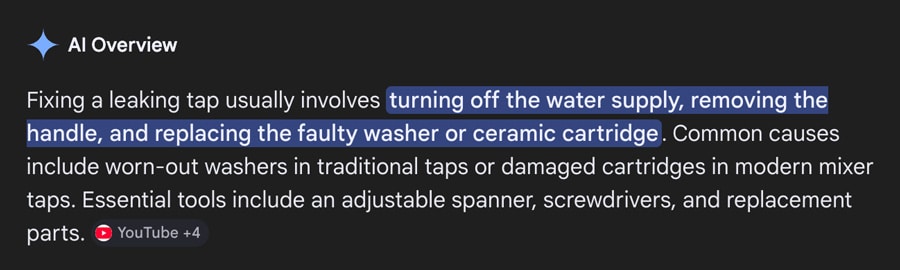
Search engines and AI systems interpret this network of related content as evidence that the site has deep expertise in plumbing topics, increasing the likelihood that its pages will be referenced, summarized, or recommended in search results and AI-generated answers.
Search engines want to see that your website understands the topic, not that it mentions the topic occasionally. The goal is not volume. It’s coherence.
Technical Signals Still Matter
Content clarity is critical, but technical SEO still plays an important role. Structured data helps search engines understand what your page represents. Schema markup, article metadata, and well-organized HTML structure provide context that improves interpretation.
Performance also matters. Pages that load quickly and maintain clean code structures tend to be easier for search systems to crawl and analyze. These types of performance issues can also impact your website’s bounce rate. Think of these technical elements as the infrastructure supporting your content. Without them, even well-written pages can struggle to surface.
The Real Strategy for AI Search
Many businesses are searching for shortcuts to “AI SEO.” There isn’t one. The same fundamentals that have always driven strong search visibility still apply: clear explanations, thoughtful structure, credible expertise, and technically sound websites. What has changed is how those signals are used. Instead of simply ranking pages, search engines are now selecting sources.
The websites that earn those citations are usually the ones that treat their content like a reference library rather than a marketing brochure. And that’s where the opportunity lives.

Search is evolving with AI.
Is your SEO strategy keeping up?
Book a consultation with our team to improve your online visibility and prepare your website for the future of search.